SCD Types Explained: Slowly Changing Dimensions Guide
Understand SCD Types 0, 1, 2, 3 and 6 in data engineering. Covers implementation strategies, SQL examples, and when to use each in modern data warehouses.
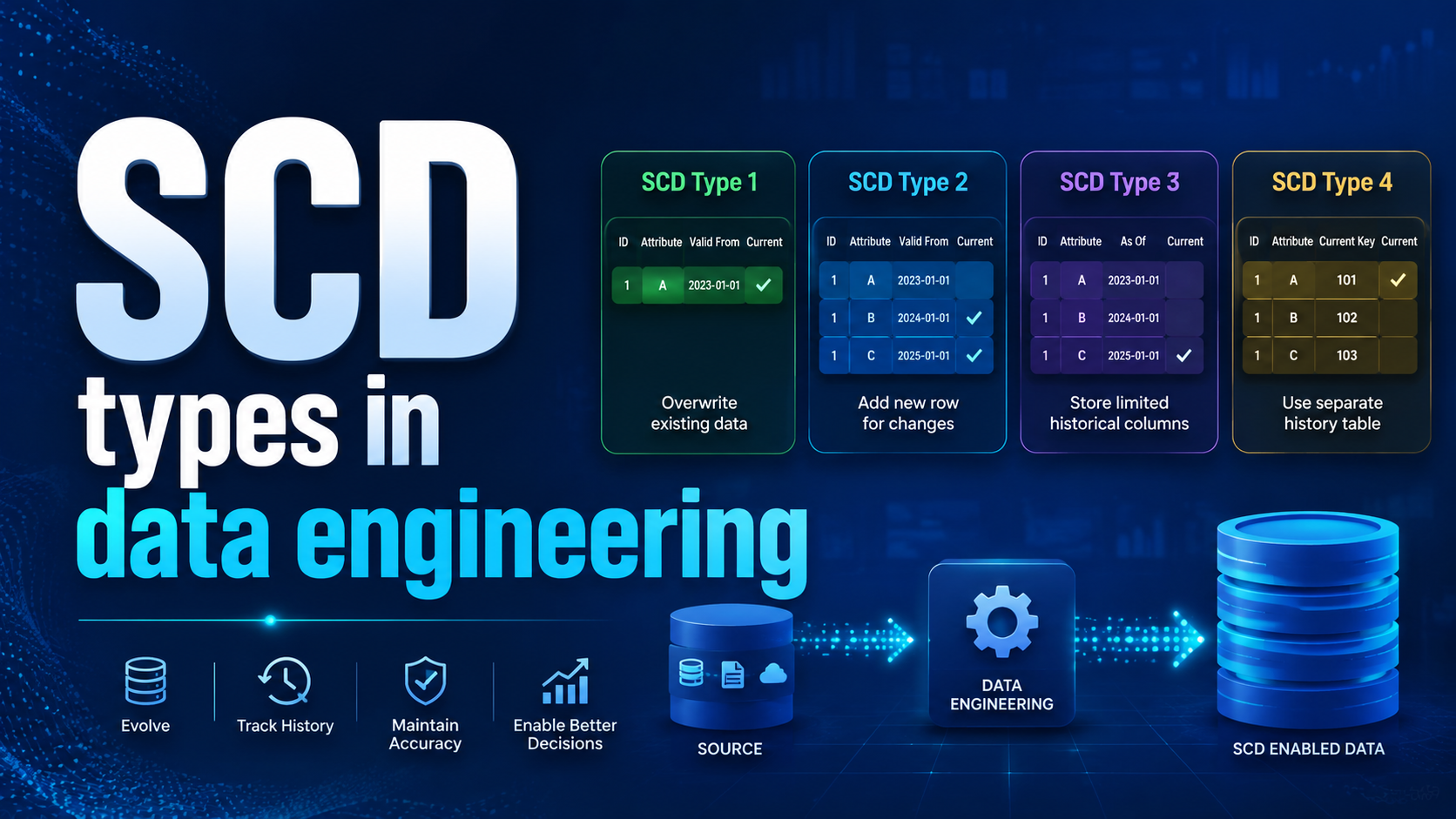
Slowly Changing Dimensions (SCD) — Made Simple 🧠
SCDs describe how a data warehouse handles changes to dimension data over time (like a customer changing their address, or an employee getting promoted).
Think of it like this: “When something about a person/thing changes, what do I do with the old info?”
🎯 The Easy Memory Trick
Imagine “Sarah moved from New York to Los Angeles.” Here’s how each SCD type reacts:
| Type | Nickname | What it does | Sarah Example |
|---|---|---|---|
| Type 0 | 🗿 “Frozen” / Retain | Never changes. Original stays forever. | Stays “New York” forever (e.g., birth city) |
| Type 1 | ✏️ “Overwrite” | Replace old with new. No history. | “Los Angeles” replaces “New York” — gone! |
| Type 2 | 📚 “Add a Row” | Keep history by adding a new row. | Two rows: one for NY (expired), one for LA (current) |
| Type 3 | ➕ “Add a Column” | Keep limited history in extra columns. | Columns: Current_City = LA, Previous_City = NY |
| Type 4 | 🗄️ “History Table” | Current data in main table; history in a separate table. | Main: LA. History table: NY record |
| Type 6 | 🎯 “1+2+3 Combo” | Hybrid (1+2+3 = 6). Best of all worlds. | New row added (Type 2) + current flag (Type 1) + previous column (Type 3) |
🧠 Memory hack: “0 = Never, 1 = Overwrite, 2 = New Row, 3 = New Column, 4 = New Table, 6 = Combo (1+2+3)”
📊 Visual Example
Original Row:
1
2
CustID | Name  | City
101    | Sarah | New York
Type 1 (Overwrite)
1
101 | Sarah | Los Angeles   ← History lost
Type 2 (Add Row + flags)
1
2
3
SurrogateKey | CustID | Name  | City        | StartDate  | EndDate    | IsCurrent
1            | 101    | Sarah | New York    | 2020-01-01 | 2024-05-01 | N
2            | 101    | Sarah | Los Angeles | 2024-05-02 | 9999-12-31 | Y
Type 3 (Add Column)
1
101 | Sarah | Current_City=LA | Previous_City=NY
Type 4 (Separate History Table)
1
2
Main:    101 | Sarah | LA
History: 101 | NY | 2020–2024
Type 6 (Hybrid)
1
2
3
SK | CustID | Name  | Hist_City | Curr_City | Start      | End        | Flag
1  | 101    | Sarah | NY        | LA        | 2020-01-01 | 2024-05-01 | N
2  | 101    | Sarah | LA        | LA        | 2024-05-02 | 9999-12-31 | Y
💼 Interview Tips & Tricks
🔥 Most Common Questions
“Which SCD type is most commonly used in real projects?” → Type 2 — because businesses usually want full historical tracking for analytics (e.g., “What were our sales by region as of last year?”).
“Difference between Type 1 and Type 2?” → Type 1 overwrites (no history). Type 2 adds a new row (full history preserved).
“How do you implement SCD Type 2?” → Use a surrogate key (not the natural/business key) + columns like
Start_Date,End_Date,Is_Currentflag, orVersion_Number.“Why surrogate keys for Type 2?” → Because the natural key (e.g., CustID 101) repeats across rows. Surrogate key uniquely identifies each version.
“What’s the disadvantage of Type 2?” → Table grows large quickly → storage + slower queries. Needs careful indexing.
“When would you use Type 3?” → When you only need to track previous + current (limited history). E.g., a sales rep’s previous and current territory.
🎤 Pro Interview Tips
✅ Always give a real-world example. Don’t just define — say “For example, if a customer’s address changes…”
✅ Mention surrogate keys + active flag/date range when explaining Type 2 — interviewers love it.
✅ Tie it to business requirement. Say: “The SCD type depends on whether the business needs history. If yes → Type 2. If not → Type 1.”
✅ Know the trade-offs:
- Type 1 → Simple but no history.
- Type 2 → Full history but bigger table.
- Type 3 → Limited history, fixed columns.
- Type 4 → Clean separation, but joins needed.
- Type 6 → Powerful but complex to maintain.
✅ Tools mention: If asked about implementation — mention Informatica, SSIS, dbt, Talend, Snowflake streams/MERGE statements, or PySpark MERGE INTO depending on your stack.
✅ MERGE / UPSERT statement knowledge is a huge plus — interviewers often ask you to write SQL for SCD2 logic.
⚡ Quick One-Liner Cheat Sheet (memorize these!)
- Type 0: “Never change it.”
- Type 1: “Overwrite, no history.”
- Type 2: “New row, full history.” ⭐ most asked
- Type 3: “New column, limited history.”
- Type 4: “History in a separate table.”
- Type 6: “1 + 2 + 3 = Hybrid power.”
🧩 Bonus Trick Question
“What’s SCD Type 5?” → It’s Type 4 + Type 1 = Mini-dimension + outrigger. Rarely asked but knowing it impresses interviewers. (4 + 1 = 5 😉)