CAP Theorem Explained: Simple Terms & Interview Prep
Understand the CAP theorem (Consistency, Availability, Partition Tolerance) in layman's terms. Master distributed database tradeoffs for your next data engineering interview.
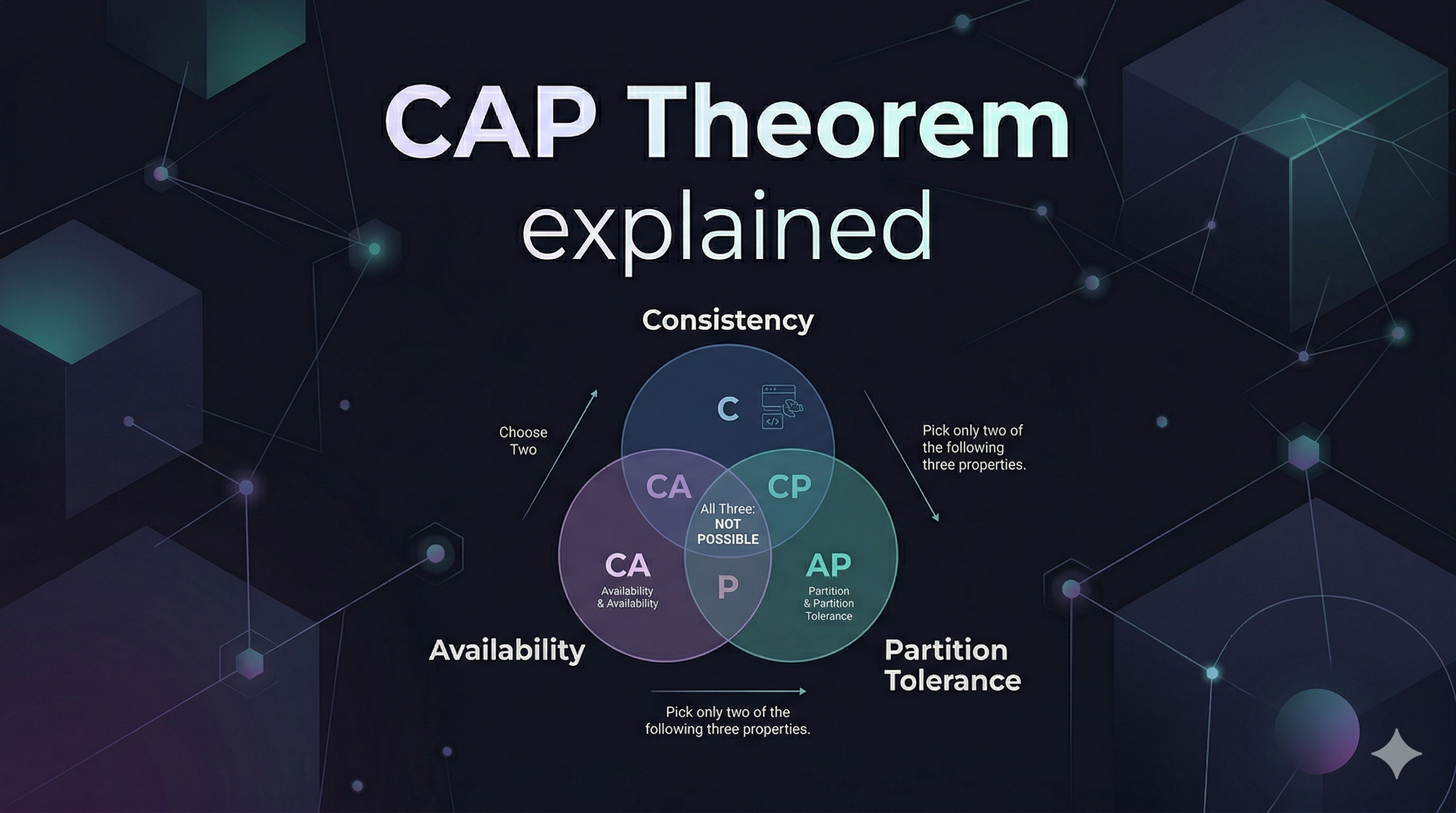
CAP Theorem
The CAP Theorem is a fundamental concept in distributed systems and a must-know topic for Data Engineering, Backend, and System Design interviews.
🧠 What is CAP Theorem? (The Elevator Pitch)
“In a distributed system, you can only guarantee 2 out of 3 properties at any given time: Consistency, Availability, and Partition Tolerance.”
Proposed by Eric Brewer in 2000 (hence also called Brewer’s Theorem).
🔺 The CAP Triangle
1
2
3
4
5
6
7
8
9
10
11
                    C (Consistency)
                   /\
                  /  \
                 /    \
            CP  /       \ CA
               /   ❌     \
              / Can't have \
             / all three!   \
            /________*_______\
     P (Partition           A (Availability)
      Tolerance)     AP
📘 The 3 Properties Explained
🔹 C — Consistency
“Every read receives the most recent write or an error.”
1
2
3
4
5
6
7
        Client writes X = 5
              │
    ┌─────────┴─────────┐
    │  Node A: X = 5    │──sync──▶│  Node B: X = 5    │
    └───────────────────┘         └───────────────────┘

    ✅ Client reads from ANY node → always gets X = 5
- All nodes see the same data at the same time
- Like a single database experience — no stale reads
- Memory aid: “Everyone agrees on the answer.”
🔹 A — Availability
“Every request receives a response (not an error), even if it’s not the most recent data.”
1
2
3
4
5
6
7
8
9
10
11
12
    Client sends request
         │
    ┌────┴────┐
    │ Node A  │ ──── ✅ Responds (maybe stale data)
    │  (UP)   │
    └─────────┘

    │ Node B  │ ──── ✅ Also responds
    │  (UP)   │
    └─────────┘

    ❌ NEVER returns: "Service Unavailable" or timeout
- System is always responsive — no downtime
- May return slightly outdated data, but always returns something
- Memory aid: “Always answers the phone, even if the info is old.”
🔹 P — Partition Tolerance
“The system continues to operate even if communication between nodes breaks.”
1
2
3
4
5
6
    ┌─────────┐         ✂️ NETWORK         ┌─────────┐
    │ Node A  │ ────── PARTITION ──────── │ Node B  │
    │ X = 5   │      (can't talk!)        │ X = 3   │
    └─────────┘                           └─────────┘

    System MUST still function despite this break!
- Network failures will happen in distributed systems (it’s not “if” but “when”)
- The system doesn’t crash — it handles the split
- Memory aid: “Survives a broken phone line between nodes.”
⚡ Why Can’t You Have All 3?
Here’s the intuitive proof — imagine a network partition happens:
1
2
3
4
    ┌─────────┐       ✂️ BROKEN        ┌─────────┐
    │ Node A  │ ─────────────────────── │ Node B  │
    │         │    (can't sync!)        │         │
    └─────────┘                         └─────────┘
Now you have a choice:
| Choice | What Happens | You Sacrifice |
|---|---|---|
| Keep Consistency | Node B refuses to respond until it syncs with A | ❌ Availability (B is down) |
| Keep Availability | Node B responds with its own (possibly stale) data | ❌ Consistency (A ≠ B) |
| Ignore Partition | Only works if partition never happens | ❌ Partition Tolerance (unrealistic) |
💡 “You can’t have a system that always responds (A), always returns the latest data (C), AND handles network splits (P) — pick two.”
🎯 The 3 Combinations
Since Partition Tolerance is mandatory in real distributed systems (networks WILL fail), the real choice is:
CP or AP? (CA is mostly theoretical)
🔹 CP — Consistency + Partition Tolerance
“I’d rather give no answer than a wrong answer.”
1
2
3
4
5
6
7
8
    ┌─────────┐    ✂️ PARTITION    ┌─────────┐
    │ Node A  │ ──────────────── │ Node B  │
    │ X = 5   │                  │ X = 3   │
    └────┬────┘                  └────┬────┘
         │                            │
    Client reads                 ❌ BLOCKED!
    from A → X = 5              "Sorry, can't guarantee
                                 consistency. Try later."
- ✅ Data is always correct
- ❌ System may be unavailable during partitions
- Use cases: Financial systems, banking, inventory management
| CP Databases | Description |
|---|---|
| MongoDB (default config) | Strong consistency, may block during partition |
| HBase | Consistent reads/writes on Hadoop |
| Redis (cluster) | Can prefer consistency |
| Zookeeper | Coordination service — consistency is critical |
| etcd | Distributed key-value store (used by Kubernetes) |
- Interview tip: “Choose CP when wrong data is worse than no data — like bank balances or seat booking.”
🔹 AP — Availability + Partition Tolerance
“I’d rather give a possibly stale answer than no answer.”
1
2
3
4
5
6
7
8
    ┌─────────┐    ✂️ PARTITION    ┌─────────┐
    │ Node A  │ ──────────────── │ Node B  │
    │ X = 5   │                  │ X = 3   │
    └────┬────┘                  └────┬────┘
         │                            │
    Client reads                 Client reads
    from A → X = 5 ✅            from B → X = 3 ✅
                                 (stale but available!)
- ✅ System is always available
- ❌ Data may be inconsistent (temporarily)
- Relies on eventual consistency — nodes will sync later
- Use cases: Social media feeds, shopping carts, DNS, CDNs
| AP Databases | Description |
|---|---|
| Cassandra | Always available, eventually consistent |
| DynamoDB | AWS managed, highly available |
| CouchDB | Availability-first document store |
| Riak | Distributed key-value, AP by design |
| Cosmos DB (configurable) | Can be tuned for AP |
- Interview tip: “Choose AP when downtime is worse than stale data — like social media likes or product catalog.”
🔹 CA — Consistency + Availability (⚠️ Theoretical)
“I want correct data AND 100% uptime — but I’m pretending network failures don’t exist.”
1
2
3
4
5
6
    ┌─────────┐    ✅ PERFECT     ┌─────────┐
    │ Node A  │ ── CONNECTION ── │ Node B  │
    │ X = 5   │   (no partition)  │ X = 5   │
    └─────────┘                  └─────────┘

    ✅ Consistent + Available... but only when network is perfect
- ⚠️ Not realistic in distributed systems — partitions WILL happen
- Only possible in single-node systems (traditional RDBMS)
| CA Systems | Description |
|---|---|
| PostgreSQL (single node) | Consistent + Available, no partition handling |
| MySQL (single node) | Same — no distribution = no partition problem |
| Oracle (single node) | Traditional RDBMS |
- Interview tip: “CA only works when there’s no distribution. The moment you go multi-node, you MUST handle partitions (P), so CA breaks.”
🗺️ The CAP Database Map
1
2
3
4
5
6
7
8
9
10
11
12
13
14
15
16
17
18
19
20
21
22
23
24
              CONSISTENCY
                  │
     ┌────────────┼────────────┐
     │            │            │
     │   MongoDB  │            │
     │   HBase    │   MySQL*   │
     │   Redis    │  PostgreSQL*│
     │   Zookeeper│  Oracle*   │
     │   etcd     │            │
     │            │            │
     │    (CP)    │   (CA*)    │
     │            │  *single   │
     │            │   node     │
  PARTITION───────┼────────────── AVAILABILITY
  TOLERANCE       │
     │            │
     │  Cassandra │
     │  DynamoDB  │
     │  CouchDB   │
     │  Riak      │
     │            │
     │    (AP)    │
     │            │
     └────────────┘
🔄 Eventual Consistency — The AP Companion
Since AP systems sacrifice consistency, they rely on eventual consistency:
“If no new updates are made, eventually all nodes will have the same data.”
1
2
3
4
5
6
7
    Time T0 (Write):          Time T1 (Syncing):        Time T2 (Consistent):

    Node A: X = 5             Node A: X = 5             Node A: X = 5
    Node B: X = 3 (stale)     Node B: X = 5 (syncing)   Node B: X = 5 ✅
    Node C: X = 3 (stale)     Node C: X = 3 (waiting)   Node C: X = 5 ✅

    ❌ Inconsistent            ⏳ Converging              ✅ Eventually Consistent
Consistency Spectrum
1
2
3
4
5
6
7
8
9
Strong ◄──────────────────────────────────────────────► Eventual
Consistency                                              Consistency

  │ Linearizable │ Sequential │ Causal │ Read-your- │ Eventual │
  │              │            │        │   writes   │          │
  │   (Strictest)│            │        │            │(Loosest) │
  │              │            │        │            │          │
  │   Zookeeper  │   etcd     │        │  DynamoDB  │Cassandra │
  │   Spanner    │            │        │            │  CouchDB │
🆕 PACELC Theorem — The Extended CAP
“CAP only talks about what happens during a partition. But what about when things are normal?”
PACELC says:
1
2
3
4
5
6
7
8
9
10
11
12
13
IF (Partition happens):
    Choose between Availability (A) and Consistency (C)
ELSE (normal operation):
    Choose between Latency (L) and Consistency (C)

P A C / E L C
│ │ │   │ │ │
│ │ │   │ │ └── Consistency
│ │ │   │ └──── Latency
│ │ │   └────── Else (no partition)
│ │ └────────── Consistency
│ └──────────── Availability
└────────────── Partition
| System | During Partition (PAC) | Else (ELC) | Full Classification |
|---|---|---|---|
| Cassandra | PA (Available) | EL (Low Latency) | PA/EL |
| DynamoDB | PA (Available) | EL (Low Latency) | PA/EL |
| MongoDB | PC (Consistent) | EC (Consistent) | PC/EC |
| HBase | PC (Consistent) | EC (Consistent) | PC/EC |
| Cosmos DB | PA (configurable) | EL (configurable) | PA/EL (tunable) |
- Interview tip: “PACELC extends CAP by adding the latency vs consistency tradeoff during normal operations. It’s a more complete picture.”
🎯 Real-World Scenario Decisions
| Scenario | Choose | Why |
|---|---|---|
| Bank account balance | CP | Wrong balance = disaster. Better to block than show wrong amount |
| Flight seat booking | CP | Can’t sell the same seat twice |
| Social media likes | AP | Showing 999 vs 1000 likes temporarily is fine |
| Shopping cart | AP | Cart should always work; sync later |
| DNS (Domain Name System) | AP | Must always resolve; slight staleness is OK |
| Stock trading | CP | Trades must be accurate and ordered |
| Chat messages | AP | Message delivery > perfect ordering |
| Inventory count | CP | Can’t oversell; block if unsure |
🎤 Top Interview Questions & Answers
| # | Question | Best Answer |
|---|---|---|
| 1 | What is CAP theorem? | In a distributed system, you can guarantee only 2 of 3: Consistency, Availability, Partition Tolerance |
| 2 | Can you have all 3? | No. During a network partition, you must choose between C and A |
| 3 | Is CA realistic? | Only for single-node systems. In distributed systems, P is mandatory, so real choice is CP vs AP |
| 4 | What does Cassandra choose? | AP — always available, eventually consistent |
| 5 | What does MongoDB choose? | CP — prefers consistency, may be unavailable during partition |
| 6 | What is eventual consistency? | All nodes will converge to the same value eventually, if no new writes occur |
| 7 | When would you pick CP? | When wrong data is worse than no data (banking, inventory, booking) |
| 8 | When would you pick AP? | When downtime is worse than stale data (social media, DNS, carts) |
| 9 | What is PACELC? | Extension of CAP: during Partition choose A/C, Else choose Latency/Consistency |
| 10 | Is CAP a strict rule? | It’s a spectrum — systems can be tuned. E.g., Cosmos DB lets you configure consistency levels |
🏁 Quick Revision Cheat Sheet
1
2
3
4
5
6
7
8
9
10
11
12
13
14
🔺 CAP = Consistency + Availability + Partition Tolerance (pick 2)
🌐 P is mandatory in distributed systems → Real choice: CP vs AP

CP  → "Correct or nothing"     → Banks, Bookings     → MongoDB, HBase, Zookeeper
AP  → "Always respond"         → Social, Carts, DNS  → Cassandra, DynamoDB, CouchDB
CA  → "Only single-node"       → Traditional RDBMS   → PostgreSQL*, MySQL* (*single node)

🔄 Eventual Consistency = AP systems sync data over time
📐 PACELC = CAP + (Else: Latency vs Consistency)

Memory Aid:
  C = "Everyone sees the SAME thing"
  A = "Everyone gets a RESPONSE"
  P = "Survives a NETWORK BREAK"
💡 Pro Interview Tip: When asked about CAP, don’t just define it — give a real-world analogy:
“Imagine two bank branches (Node A & B) with the phone line cut (partition). A customer deposits ₹10,000 at Branch A. Now Branch B has two options:
- CP: Block all queries about that account until the phone line is restored (consistent but unavailable)
- AP: Show the old balance and sync later (available but inconsistent)
You can’t do both — that’s CAP theorem in action.”