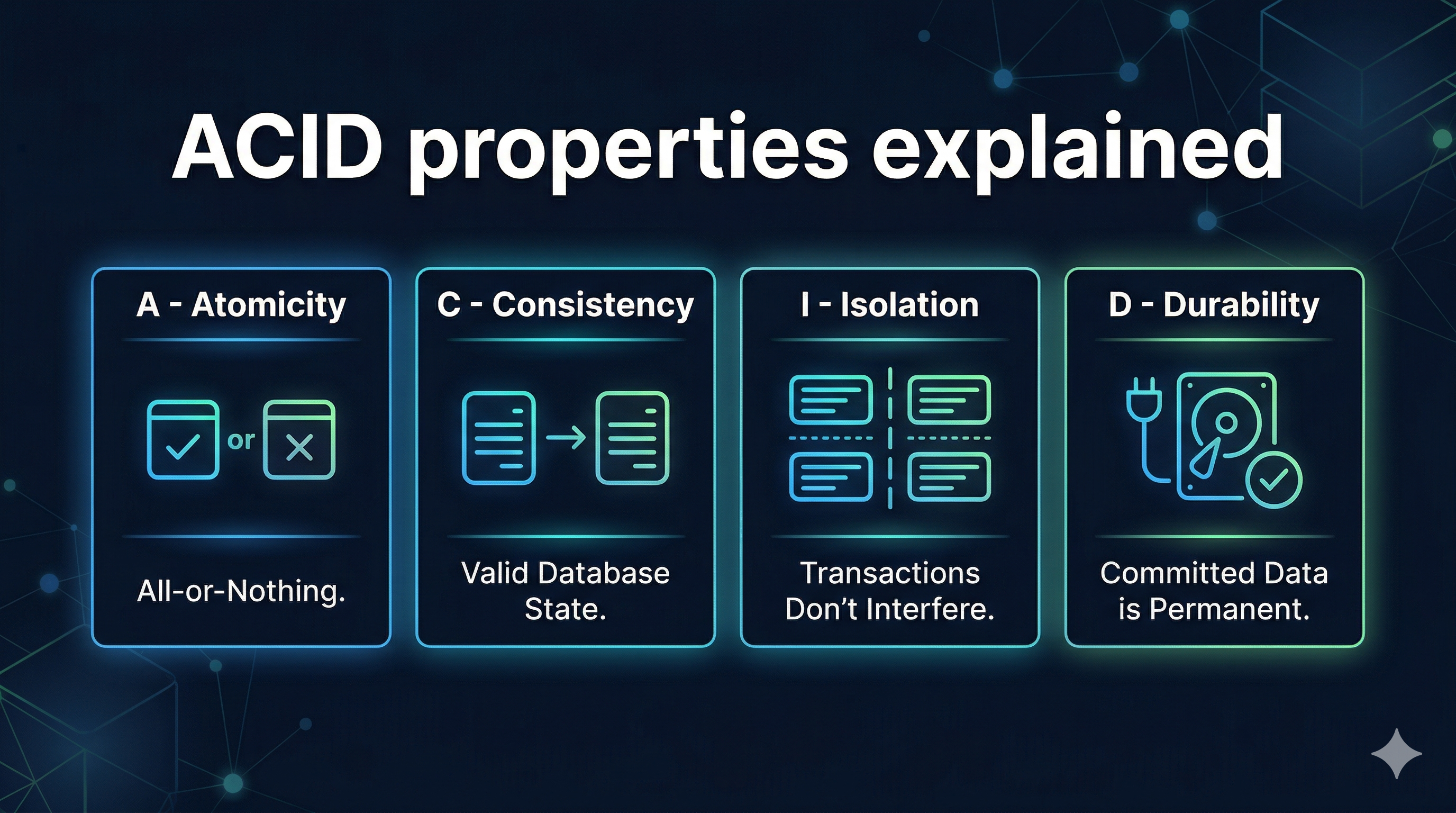
ACID Properties – Complete Interview Guide 🎯
ACID properties are the backbone of reliable database transactions. This is a must-know topic for Data Engineering, Backend, Database, and System Design interviews.
🧠 What are ACID Properties? (The Elevator Pitch)
“ACID is a set of 4 guarantees that ensure database transactions are processed reliably, even in the face of errors, crashes, or concurrent access.”
🏦 The Real-World Analogy — Bank Transfer
Let’s use a ₹5,000 transfer from Kedar → Raj as our running example throughout:
1
2
3
4
5
6
7
8
| Kedar's Account Raj's Account
Balance: ₹20,000 Balance: ₹10,000
Step 1: Debit Kedar → ₹20,000 - ₹5,000 = ₹15,000
Step 2: Credit Raj → ₹10,000 + ₹5,000 = ₹15,000
✅ Both steps MUST succeed together
❌ If only Step 1 runs → ₹5,000 disappears into thin air!
|
This is exactly what ACID prevents. Let’s break it down:
🔤 A.C.I.D — The 4 Properties
1
2
3
4
5
6
7
8
9
10
11
12
13
| ┌─────────────────────────────────────────────────────────┐
│ A.C.I.D │
├──────────────┬──────────────┬─────────────┬─────────────┤
│ Atomicity │ Consistency │ Isolation │ Durability │
├──────────────┼──────────────┼─────────────┼─────────────┤
│ "All or │ "Valid state │"Transactions│ "Once saved,│
│ Nothing" │ to valid │ don't │ it stays │
│ │ state" │ interfere" │ saved" │
├──────────────┼──────────────┼─────────────┼─────────────┤
│ 💣 Bomb │ 📏 Rules │ 🧱 Walls │ 💾 Cement │
│ defusal │ of the game │ between │ it in │
│ analogy │ │ players │ stone │
└──────────────┴──────────────┴─────────────┴─────────────┘
|
🔹 A — Atomicity (“All or Nothing”) 💣
“Either ALL operations in a transaction succeed, or NONE of them do. There’s no in-between.”
The Analogy
“Like defusing a bomb — you either cut ALL the right wires, or the whole thing resets. You can’t leave it half-defused.”
Example
1
2
3
4
| BEGIN TRANSACTION;
UPDATE accounts SET balance = balance - 5000 WHERE user = 'Kedar'; -- Step 1 ✅
UPDATE accounts SET balance = balance + 5000 WHERE user = 'Raj'; -- Step 2 ❌ ERROR!
ROLLBACK; -- ⬅️ Step 1 is also UNDONE. Kedar gets his money back.
|
1
2
3
4
5
6
7
8
| ✅ SUCCESS Scenario: ❌ FAILURE Scenario:
Step 1: Debit Kedar ✅ Step 1: Debit Kedar ✅
Step 2: Credit Raj ✅ Step 2: Credit Raj ❌ (crash!)
COMMIT ✅ ROLLBACK ↩️ (Step 1 undone!)
Kedar: ₹15,000 Kedar: ₹20,000 (restored!)
Raj: ₹15,000 Raj: ₹10,000 (unchanged)
|
How Databases Implement It
| Mechanism | How It Works |
|---|
| Write-Ahead Log (WAL) | Log all changes BEFORE applying them. On crash, replay or undo from log |
| Undo Log | Records the old values so changes can be rolled back |
| Shadow Paging | Writes to a copy; swap pointers only on commit |
- Interview tip: “Atomicity = a transaction is an indivisible unit. If any part fails, the entire transaction rolls back. Think of it as a single atomic operation.”
🔹 C — Consistency (“Valid State → Valid State”) 📏
“A transaction takes the database from one valid state to another valid state. All rules, constraints, and invariants are maintained.”
The Analogy
“Like the rules of chess — every move must result in a legal board position. You can’t end a move with two kings on the same square.”
Example
1
2
3
4
5
6
7
8
9
10
11
| RULE: Total money in the system must ALWAYS = ₹30,000
(Kedar ₹20,000 + Raj ₹10,000 = ₹30,000)
Before Transaction:
Kedar: ₹20,000 + Raj: ₹10,000 = ₹30,000 ✅
After Transaction:
Kedar: ₹15,000 + Raj: ₹15,000 = ₹30,000 ✅
❌ INVALID State (Consistency Violated):
Kedar: ₹15,000 + Raj: ₹10,000 = ₹25,000 ❌ (₹5,000 vanished!)
|
What Consistency Enforces
1
2
3
4
5
6
7
8
9
10
11
12
| ┌──────────────────────────────────────────────────────┐
│ CONSISTENCY CHECKS │
├────────────────────┬─────────────────────────────────┤
│ Primary Keys │ No duplicates, not null │
│ Foreign Keys │ References must exist │
│ Unique Constraints │ No duplicate emails, usernames │
│ Check Constraints │ age > 0, balance >= 0 │
│ Triggers │ Custom business rules │
│ Data Types │ INT field can't hold "hello" │
│ NOT NULL │ Required fields must have values │
│ Business Rules │ Total money conserved │
└────────────────────┴─────────────────────────────────┘
|
Example — Constraint Violation
1
2
3
4
5
6
7
8
| -- Constraint: balance >= 0
BEGIN TRANSACTION;
UPDATE accounts SET balance = balance - 25000 WHERE user = 'Kedar';
-- ❌ FAILS! balance would be ₹20,000 - ₹25,000 = -₹5,000
-- Violates CHECK constraint: balance >= 0
ROLLBACK;
-- Database stays in valid state ✅
|
- Interview tip: “Consistency is about rules. The database was valid before, and it MUST be valid after. It’s the application + database working together to enforce invariants.”
🔹 I — Isolation (“Transactions Don’t Interfere”) 🧱
“Concurrent transactions execute as if they were running one after another (serially). One transaction can’t see another’s uncommitted changes.”
The Analogy
“Like exam halls — each student (transaction) works independently. You can’t peek at another student’s answer sheet (uncommitted data).”
The Problem Without Isolation
1
2
3
4
5
6
7
8
9
10
11
| Transaction A Transaction B
(Kedar → Raj ₹5,000) (Read Kedar's balance)
───────────────── ─────────────────
1. Read Kedar: ₹20,000
2. Debit Kedar: ₹15,000
3. Read Kedar: ₹15,000 ← DIRTY READ!
4. ❌ CRASH → ROLLBACK (This data was never committed!)
Kedar back to ₹20,000
5. Transaction B used ₹15,000
which was WRONG! 💀
|
The 4 Read Problems
1
2
3
4
5
6
7
8
9
10
11
12
13
14
15
16
17
18
| ┌──────────────────────────────────────────────────────────────┐
│ READ PROBLEMS │
├─────────────────┬────────────────────────────────────────────┤
│ 🔴 Dirty Read │ Reading data that was NEVER COMMITTED │
│ │ "Seeing someone's draft before they send" │
├─────────────────┼────────────────────────────────────────────┤
│ 🟡 Non-Repeatable│ Same query returns DIFFERENT VALUES │
│ Read │ because another txn modified & committed │
│ │ "Price changed while you were checking out"│
├─────────────────┼────────────────────────────────────────────┤
│ 🟠 Phantom Read │ Same query returns DIFFERENT NUMBER OF ROWS│
│ │ because another txn inserted/deleted rows │
│ │ "New items appeared in your search results"│
├─────────────────┼────────────────────────────────────────────┤
│ 🔵 Lost Update │ Two txns update the same row; one │
│ │ overwrites the other's change │
│ │ "Two people editing the same doc" │
└─────────────────┴────────────────────────────────────────────┘
|
Detailed Examples of Each Problem
🔴 Dirty Read:
1
2
3
4
| Txn A: UPDATE balance SET ₹15,000 (not committed yet)
Txn B: SELECT balance → reads ₹15,000 ← DIRTY!
Txn A: ROLLBACK → balance is back to ₹20,000
Txn B: Already used ₹15,000... WRONG! 💀
|
🟡 Non-Repeatable Read:
1
2
3
| Txn A: SELECT price WHERE id=1 → ₹100
Txn B: UPDATE price SET ₹150 WHERE id=1 → COMMIT ✅
Txn A: SELECT price WHERE id=1 → ₹150 ← DIFFERENT! 😱
|
🟠 Phantom Read:
1
2
3
| Txn A: SELECT COUNT(*) WHERE city='Mumbai' → 5 rows
Txn B: INSERT INTO customers (city='Mumbai') → COMMIT ✅
Txn A: SELECT COUNT(*) WHERE city='Mumbai' → 6 rows ← PHANTOM! 👻
|
🔒 Isolation Levels (From Lowest to Highest)
1
2
3
4
5
6
7
8
9
10
11
12
13
| WEAKEST STRONGEST
(Fastest) (Slowest)
───────────────────────────────────────────────────────────────
Read Read Repeatable Serializable
Uncommitted Committed Read
│ │ │ │
│ Allows: │ Prevents: │ Prevents: │ Prevents:
│ Everything │ Dirty Reads │ Dirty Reads │ ALL problems
│ │ │ Non-Repeatable │
│ ⚡ Fastest │ │ Reads │ 🐢 Slowest
│ ❌ Unsafe │ 🟡 Moderate │ 🟢 Safe │ ✅ Safest
───────────────────────────────────────────────────────────────
|
Isolation Level vs Problems Matrix
| Isolation Level | Dirty Read | Non-Repeatable Read | Phantom Read | Performance |
|---|
| Read Uncommitted | ❌ Possible | ❌ Possible | ❌ Possible | ⚡⚡⚡⚡ Fastest |
| Read Committed | ✅ Prevented | ❌ Possible | ❌ Possible | ⚡⚡⚡ Fast |
| Repeatable Read | ✅ Prevented | ✅ Prevented | ❌ Possible | ⚡⚡ Medium |
| Serializable | ✅ Prevented | ✅ Prevented | ✅ Prevented | ⚡ Slowest |
What Databases Default To
| Database | Default Isolation Level |
|---|
| PostgreSQL | Read Committed |
| MySQL (InnoDB) | Repeatable Read |
| Oracle | Read Committed |
| SQL Server | Read Committed |
| SQLite | Serializable |
- Interview tip: “Isolation is a spectrum — you trade off safety for performance. Most production systems use Read Committed as a balance.”
🔹 D — Durability (“Once Saved, It Stays Saved”) 💾
“Once a transaction is committed, the changes are permanent — even if the system crashes immediately after.”
The Analogy
“Like carving in stone — once it’s engraved, even a power cut can’t erase it. Unlike writing on a whiteboard.”
Example
1
2
3
4
5
6
7
8
9
10
11
12
13
14
| BEGIN TRANSACTION;
UPDATE accounts SET balance = ₹15,000 WHERE user = 'Kedar';
UPDATE accounts SET balance = ₹15,000 WHERE user = 'Raj';
COMMIT; ✅ ← At this exact moment, it's PERMANENT
💥 SERVER CRASHES 0.001 seconds later!
🔄 Server restarts...
SELECT balance FROM accounts WHERE user = 'Kedar';
→ ₹15,000 ✅ (Still there! Not lost!)
SELECT balance FROM accounts WHERE user = 'Raj';
→ ₹15,000 ✅ (Still there! Not lost!)
|
How Databases Ensure Durability
1
2
3
4
5
6
7
8
9
10
11
12
13
14
15
16
17
18
| ┌──────────────────────────────────────────────────────────┐
│ DURABILITY MECHANISMS │
├──────────────────────┬───────────────────────────────────┤
│ Write-Ahead Log (WAL)│ Changes logged to disk BEFORE │
│ │ applying. On crash, replay log. │
├──────────────────────┼───────────────────────────────────┤
│ Redo Log │ Records committed changes. │
│ │ Replays on recovery. │
├──────────────────────┼───────────────────────────────────┤
│ Checkpointing │ Periodically flush in-memory │
│ │ changes to disk. │
├──────────────────────┼───────────────────────────────────┤
│ Replication │ Copy data to multiple nodes. │
│ │ If one dies, others have it. │
├──────────────────────┼───────────────────────────────────┤
│ Battery-backed cache │ Hardware ensures write cache |
│ │ survives power failure. │
└──────────────────────┴───────────────────────────────────┘
|
- Interview tip: “Durability means committed = permanent. Databases achieve this through WAL (Write-Ahead Logging) and replication.”
🔄 Complete Transaction Lifecycle
1
2
3
4
5
6
7
8
9
10
11
12
13
14
15
16
17
18
19
20
21
22
23
24
25
26
27
28
29
| ┌─────────────┐
│ BEGIN │
│ TRANSACTION │
└──────┬──────┘
│
▼
┌─────────────┐ ┌───────────────────────────────┐
│ Execute │ │ ACID in Action: │
│ Operations │ │ │
│ │ │ A: All ops tracked as a unit │
│ - Debit │ │ C: Constraints checked │
│ - Credit │ │ I: Isolated from other txns │
│ - Validate │ │ D: Changes logged to WAL │
└──────┬──────┘ └───────────────────────────────┘
│
┌───┴───┐
│Error? │
└───┬───┘
/ \
Yes No
/ \
▼ ▼
┌──────────┐ ┌──────────┐
│ ROLLBACK │ │ COMMIT │
│ │ │ │
│ Undo ALL │ │ Write to │
│ changes │ │ disk │
│ (Atom.) │ │ (Dura.) │
└──────────┘ └──────────┘
|
⚖️ ACID vs BASE
In the world of NoSQL and distributed systems, there’s an alternative philosophy called BASE:
1
2
3
4
5
| ACID (RDBMS) BASE (NoSQL)
──────────── ────────────
Strong Consistency Eventual Consistency
Strict Rules Flexible Rules
Pessimistic Optimistic
|
| | ACID | BASE |
|---|
| Full Form | Atomicity, Consistency, Isolation, Durability | Basically Available, Soft state, Eventual consistency |
| Philosophy | “Be correct at all costs” | “Be available at all costs” |
| Consistency | Strong (immediate) | Eventual (over time) |
| Transactions | Strict, locked | Flexible, optimistic |
| Performance | Lower (more locks) | Higher (fewer locks) |
| Scalability | Vertical (scale up) | Horizontal (scale out) |
| Use Case | Banking, Inventory, Booking | Social Media, IoT, Caching |
| Examples | PostgreSQL, MySQL, Oracle | Cassandra, DynamoDB, MongoDB |
BASE Explained
1
2
3
4
5
6
7
8
9
10
11
| B.A. → Basically Available
System guarantees availability (may serve stale data)
"The store is always open, even if some shelves aren't restocked yet"
S. → Soft State
State may change over time even without new input (due to syncing)
"The system is always in flux — data is flowing between nodes"
E. → Eventual Consistency
Given enough time, all nodes will converge to the same state
"Everyone will eventually get the memo"
|
- Interview tip: “ACID = pessimistic, prioritizes correctness. BASE = optimistic, prioritizes availability. Choose based on your use case.”
🔗 ACID + CAP Connection
1
2
3
4
5
6
7
8
9
10
11
12
13
14
15
| ┌──────────────┬────────────────────────────────────┐
│ CAP Choice │ ACID Behavior │
├──────────────┼────────────────────────────────────┤
│ CP Systems │ Full ACID (strong consistency) │
│ (MongoDB, │ Transactions are strict │
│ HBase) │ │
├──────────────┼────────────────────────────────────┤
│ AP Systems │ BASE (eventual consistency) │
│ (Cassandra, │ Relaxed ACID, flexible │
│ DynamoDB) │ │
├──────────────┼────────────────────────────────────┤
│ CA Systems │ Full ACID (traditional RDBMS) │
│ (PostgreSQL, │ Single-node, no partitions │
│ MySQL) │ │
└──────────────┴────────────────────────────────────┘
|
🧪 SQL Examples — ACID in Action
Atomicity Example
1
2
3
4
5
6
7
8
9
10
11
12
13
14
15
| -- Transfer ₹5,000 from Kedar to Raj
BEGIN TRANSACTION;
UPDATE accounts SET balance = balance - 5000
WHERE user_id = 'Kedar' AND balance >= 5000; -- Check sufficient funds (Consistency)
IF @@ROWCOUNT = 0
ROLLBACK; -- ❌ Insufficient funds → undo everything (Atomicity)
RETURN;
END IF;
UPDATE accounts SET balance = balance + 5000
WHERE user_id = 'Raj';
COMMIT; -- ✅ Both succeeded → make permanent (Durability)
|
Isolation Example
1
2
3
4
5
6
7
8
| -- Set isolation level explicitly
SET TRANSACTION ISOLATION LEVEL SERIALIZABLE;
BEGIN TRANSACTION;
SELECT balance FROM accounts WHERE user_id = 'Kedar'; -- Locked! 🔒
-- No other transaction can modify Kedar's balance until we COMMIT
UPDATE accounts SET balance = balance - 5000 WHERE user_id = 'Kedar';
COMMIT; -- Lock released 🔓
|
Consistency Example
1
2
3
4
5
6
7
8
9
10
11
| -- Constraints enforce consistency automatically
CREATE TABLE accounts (
user_id VARCHAR(50) PRIMARY KEY, -- No duplicates
balance DECIMAL(15,2) CHECK (balance >= 0), -- No negative balance
email VARCHAR(255) UNIQUE NOT NULL, -- Required & unique
created_at TIMESTAMP DEFAULT CURRENT_TIMESTAMP
);
-- This will FAIL → maintains consistency
UPDATE accounts SET balance = -500 WHERE user_id = 'Kedar';
-- ❌ ERROR: CHECK constraint violated (balance >= 0)
|
🎯 Memory Aid — The ACID Story
Imagine you’re at an ATM withdrawing money:
A (Atomicity): The ATM either gives you the cash AND debits your account, or does neither. It won’t debit without dispensing. “All or nothing.”
C (Consistency): Your total wealth doesn’t change — money moves from bank to wallet. No money created or destroyed. “Rules are followed.”
I (Isolation): If someone else is transferring to your account simultaneously, their transaction won’t mess up yours. “No interference.”
D (Durability): Once the ATM says “Transaction Successful,” even if the ATM crashes the next second, your money is safe. “It’s permanent.”
🎤 Top Interview Questions & Answers
| # | Question | Best Answer |
|---|
| 1 | What is ACID? | 4 properties guaranteeing reliable transactions: Atomicity, Consistency, Isolation, Durability |
| 2 | Explain Atomicity with an example | Bank transfer — either both debit and credit happen, or neither does |
| 3 | What’s the difference between Consistency in ACID vs CAP? | ACID Consistency = rules/constraints enforced. CAP Consistency = all nodes see same data |
| 4 | What are isolation levels? | Read Uncommitted → Read Committed → Repeatable Read → Serializable (weakest to strongest) |
| 5 | What is a dirty read? | Reading uncommitted data from another transaction that might rollback |
| 6 | Phantom vs Non-Repeatable read? | Non-Repeatable = same row, different value. Phantom = different number of rows |
| 7 | How is durability achieved? | Write-Ahead Logging (WAL), redo logs, checkpointing, replication |
| 8 | ACID vs BASE? | ACID = strict, consistent, RDBMS. BASE = flexible, eventually consistent, NoSQL |
| 9 | Which databases are ACID compliant? | PostgreSQL, MySQL (InnoDB), Oracle, SQL Server, SQLite |
| 10 | Can NoSQL be ACID? | Yes! MongoDB (4.0+) supports multi-document ACID transactions. DynamoDB has DynamoDB Transactions |
| 11 | Default isolation level of MySQL? | Repeatable Read (InnoDB engine) |
| 12 | Default isolation level of PostgreSQL? | Read Committed |
🏁 Quick Revision Cheat Sheet
1
2
3
4
5
6
7
8
9
10
11
12
13
14
15
16
17
18
19
20
21
22
| A = Atomicity → "All or Nothing" → ROLLBACK on failure
C = Consistency → "Valid → Valid" → Constraints enforced
I = Isolation → "No interference" → Isolation levels
D = Durability → "Committed = Permanent" → WAL, Redo logs
🔒 Isolation Levels (weak → strong):
Read Uncommitted → Read Committed → Repeatable Read → Serializable
🔴 Read Problems:
Dirty Read → Reading UNCOMMITTED data
Non-Repeatable → Same query, DIFFERENT values
Phantom Read → Same query, DIFFERENT number of rows
⚖️ ACID vs BASE:
ACID → Strict, Correct, RDBMS (PostgreSQL, MySQL)
BASE → Flexible, Available, NoSQL (Cassandra, DynamoDB)
🏦 ATM Analogy:
A → Cash + Debit happen TOGETHER
C → Total money conserved
I → Other transactions don't interfere
D → "Success" message = money is SAFE forever
|
💡 Pro Interview Tip: If an interviewer asks “How do you ensure data integrity in your system?”, structure your answer as:
- Database level: ACID transactions with appropriate isolation level
- Application level: Validation, idempotency, retry logic
- Infrastructure level: Replication, backups, WAL
- Monitoring: Alerts on constraint violations, transaction failures
This shows you think holistically, not just textbook definitions!